DevConf. Every year it is slightly different. Some years it is a mad rush of running around to be ready with a talk, some years it is more relaxed and I get to support friends in their speaking madness. Every year it is a great experience, and 2026 was no different.
One of the driving forces behind making DevConf great is the community it fosters. We talk about serendipity and surprises. We talk about the OpenSpace principles of “those who show up are the right people”. What we gloss over, is the work that goes on behind the scenes to make it a place where people can show up, and do show up authentically. Diversity is not an afterthought, but neither is it forced. The speaker line up reflects that reality. No one is chosen to speak based on a quota, yet the line up is never “a bunch of white dudes”. This is a testament to the community it comes out of, and the hard work Robert and Candice have put in over the years to keep the space safe.
So, congratulations on 10 years of running a conference (in Jo’burg, Cape Town is still catching up). It is no easy feat, and we in the community salute you.
Speed Running The Talks
I cannot do justice to the amazing line up of speakers. Every year I am amazed at the quality, every year they pull out all the stops (and lose a lot of sleep and hair), and every year they share wonderful stories. What made this year slightly different, was that in almost every time slot I had to pick which friend I would attend. So, some of my choices were almost arbitrary.
Obviously everyone was in the keynote, where Chris Tite threw an appropriate amount of shade at AI, but also left us feeling hopeful about the good we can do if we keep the human in the loop. It’s a hot topic at the moment, and I appreciated the nuance he brought to it. Being human, having empathy, and solving pain points is always going to come out on top.
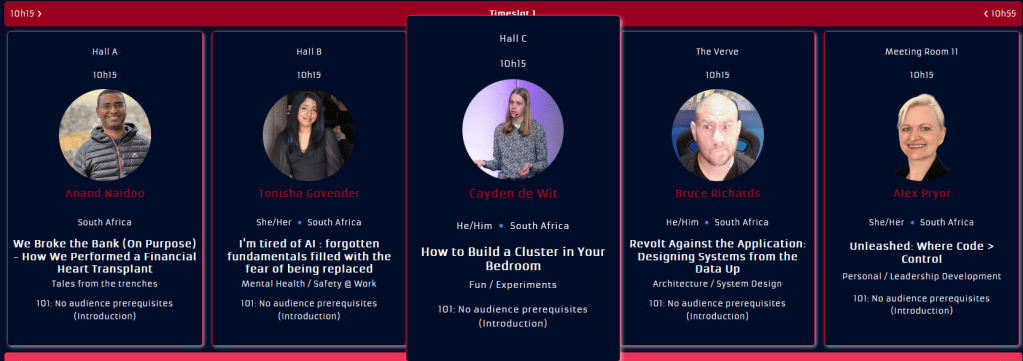
From there, I joined Cayden, who was giving a whirlwind tour of the difference between grids and clusters. He had live demos of both, and I did appreciate the slimed keyboard on of his one cluster node. When it came to grids though, there is something spectacular about the live demo crashing due to too much audience participation. With an added irony that too much scale broke the scaling system (the bottleneck was unsurprisingly the orchestrator).
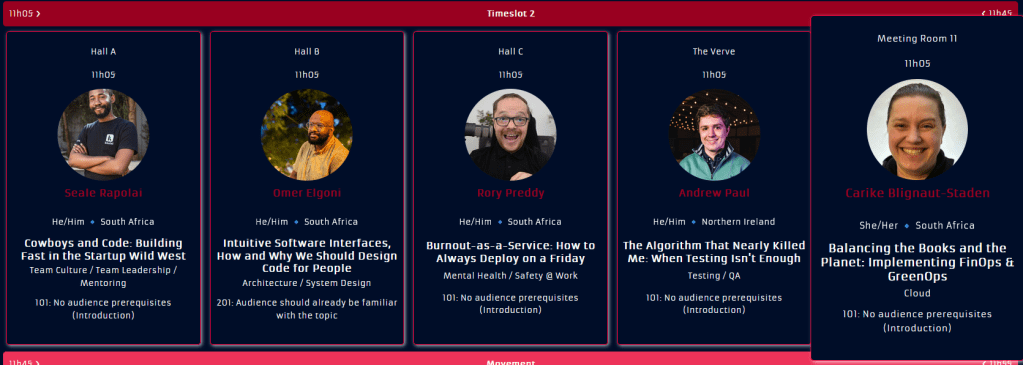
Session two (in which a pattern emerged of entering a room after the speaker started) was with Carike. She and I share a deep appreciation for the Ops side of development, so of course I was going to listen to what she had to say about FinOps and GreenOps. This talk wins my personal award for “most applicable to the day job” and “hidden gem”. Carike’s insights and direct approach is always a joy. And it led me to searching the term “green pixie” on the internet, which thankfully mostly came up with hairstyles not anything worse.
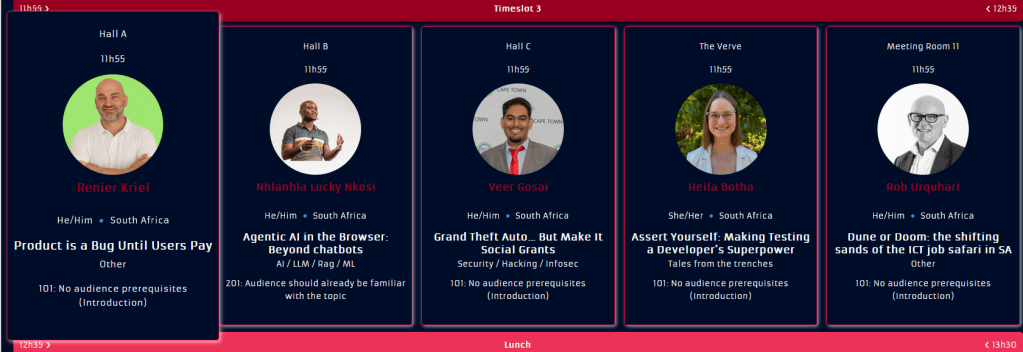
Session three I was at the mercy of the agenda, and I chose to attend Renier’s talk about what is necessary for getting a start up right. From pitch tests to needing users, it was a great insight into the business mindset needed to start something new from the ground up. Tying back to the keynote as he pointed out that you need to feel the pain of the problem you are solving to be able to develop it correctly, something humans are a lot better at than AI.
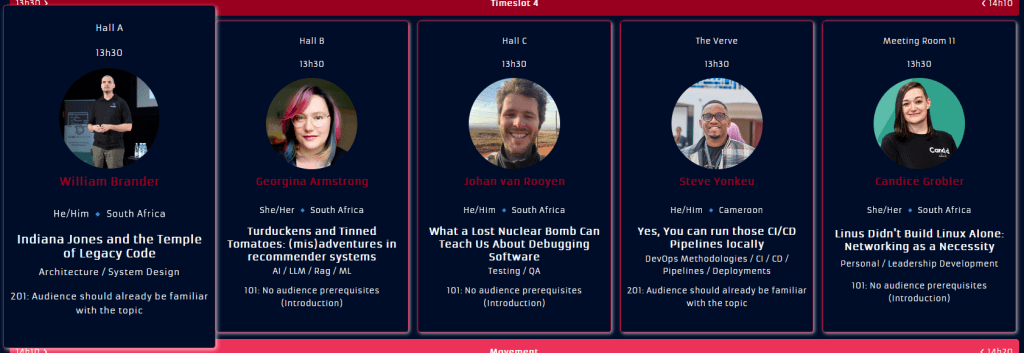
Session four was the worst choice. Five out of five options I knew I would enjoy. Thankfully two were repeats of talks I had seen previously, and so I could tell those friends I already knew their talks were great, and go see what William had to say about Indiana Jones. Having never been embedded in that franchise personally, I think I appreciated his comparison to legacy code (it doesn’t age well) better than a true fan might have. That being said, the point about “legacy” being something we leave behind and not a negative thing was well made. The legacy of Indiana Jones is undeniable, legacy code serves a purpose, no matter how gross it might seem now.
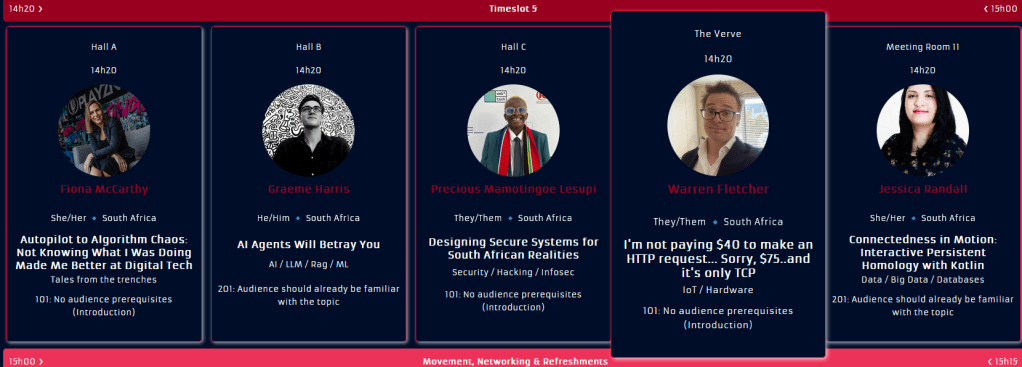
Session five came with a direct recommendation, which made the choice easy. Warren’s stories about closed source hardware in the manufacturing industry make me want to go on a Cory Doctorow level rant about capitalism, pay walls, and gate keeping. The need to be able to break open the super expensive systems and safely bring the price down on quality engineering parts is a challenge waiting to be solved. I also really want to know what they were doing which allowed them to explode an Arduino or Raspberry Pi.
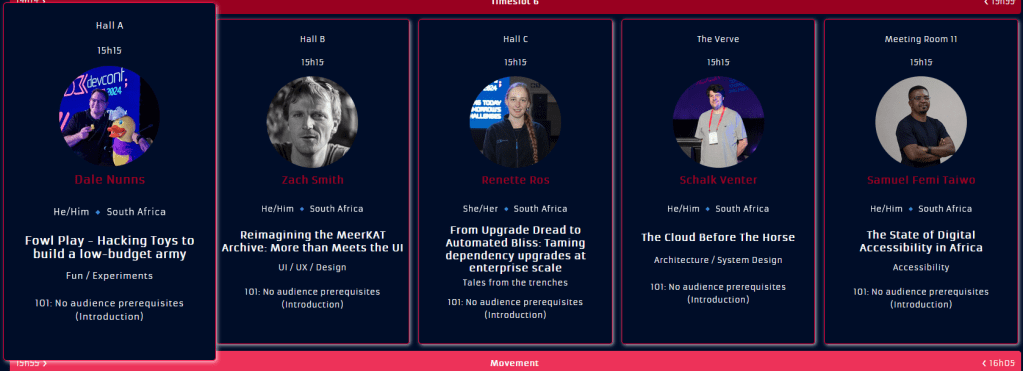
Session six was an easy choice. Except for the fact that every talk I didn’t go to touches on a special interest of mine. Nevertheless, the Duck Lord won, and I went to see what Dale did to his toys this year. From face-planting robot dogs, to the duck launcher, the message to get away from the doom-scroll and make something was well received. Dale and I both like to make strange and interesting things, he just takes it a few steps further than I do, possibly because he’s less afraid of the consequences of failure.
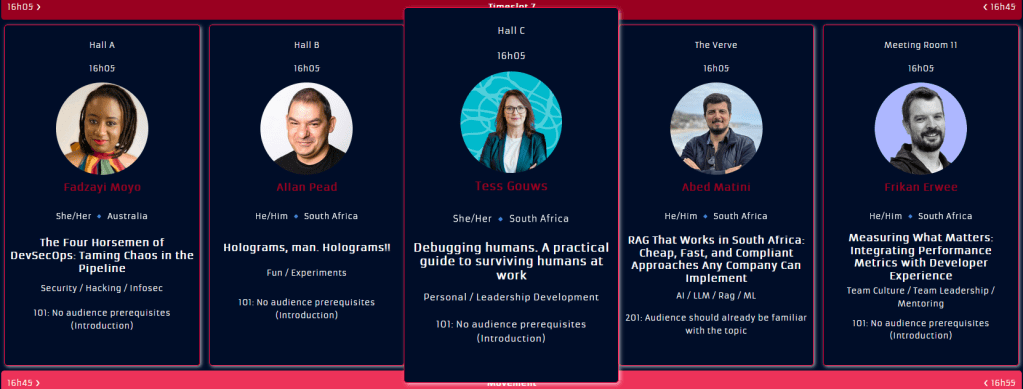
Final talk of the day (the one where you’re not sure how you’re going to stay awake) I went to see Tess speaking about something I have been working on for at least fifteen years. Humans are harder to debug than computers, because they are even less deterministic than LLMs. So, the tips and tricks that Tess was sharing, the direct and solid things we can choose to do, these were points well made. I had no trouble staying awake, which means clearly the content was riveting!
The Results
From the beginning of the day I was ready to have a great time, and build community. Our fledgling community code& was there as a community sponsor handing out tickets, finding speakers for our meetups, and just generally making sure people know we exist. Dale put out a challenge to use his #getducked tag on social posts, which of course I took ducking seriously. In return I got more duck stickers than I know what to do with, and a stuffed duck, who is now making friends with my velociraptor.
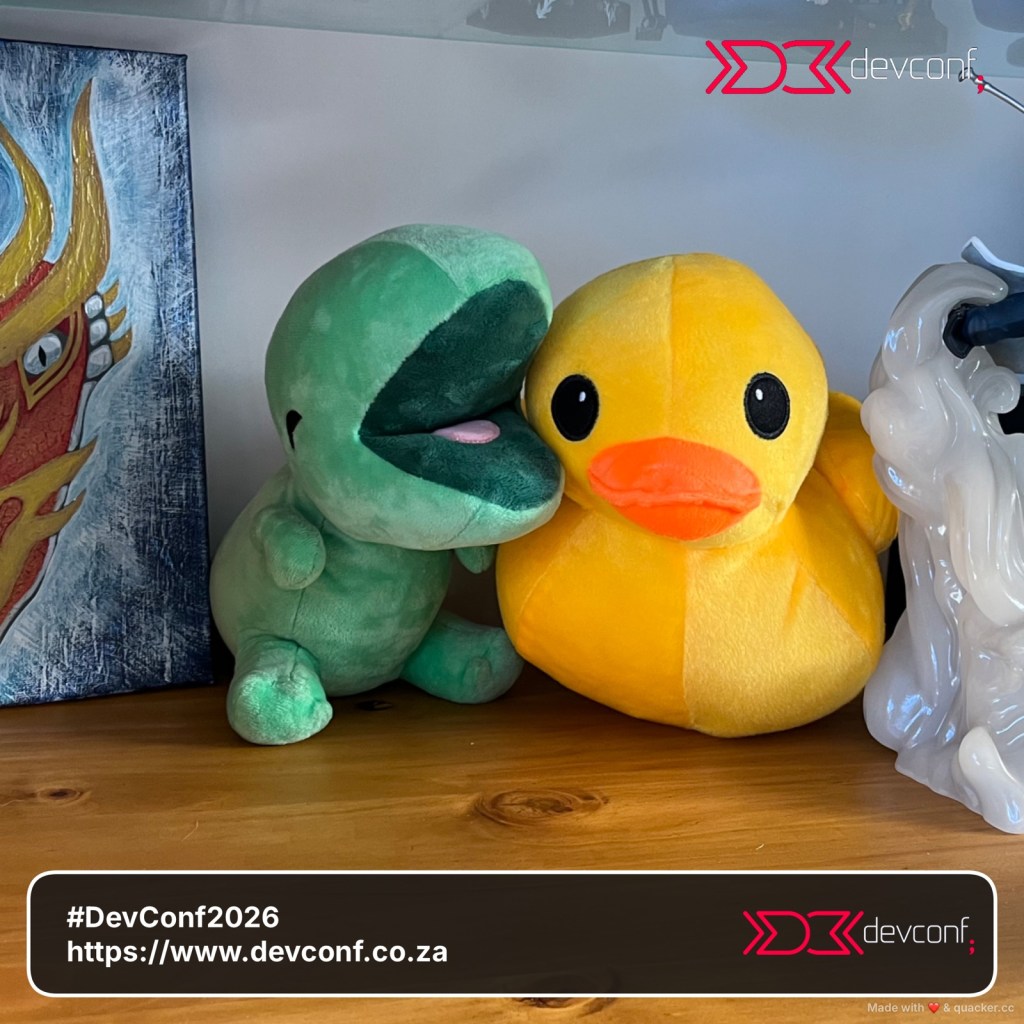
I always leave DevConf inspired. Whether it is just to go build the thing I am excited about, a fresh new project, community, or friends there is something new. So, yes I am planning out what I will submit to hopefully speak next year (if I start now, maybe I’ll have a good idea). I also have some resources I can use in my day job, and fresh ways to inject chaos into my own life. What more could I ask for?
Thank you DevConf, and I’ll see you again next year!
 Pippa Hillebrand