A controversial topic at the best of times, we don’t always like to talk about the role of AI in art and culture. I use it regularly for my work – the act of writing code is no longer something I do by hand. I don’t feel bad about that. I am still doing a good amount of engineering work. I am still the System Architect. I am still the designer, the creative, the one with a vision. The models I use are following my instructions, and sometimes managing to challenge my assumptions, but mostly looking for the most naive way to do what I say. That’s fine. What is far more interesting, I think, is where AI meets art.
Why did they try?
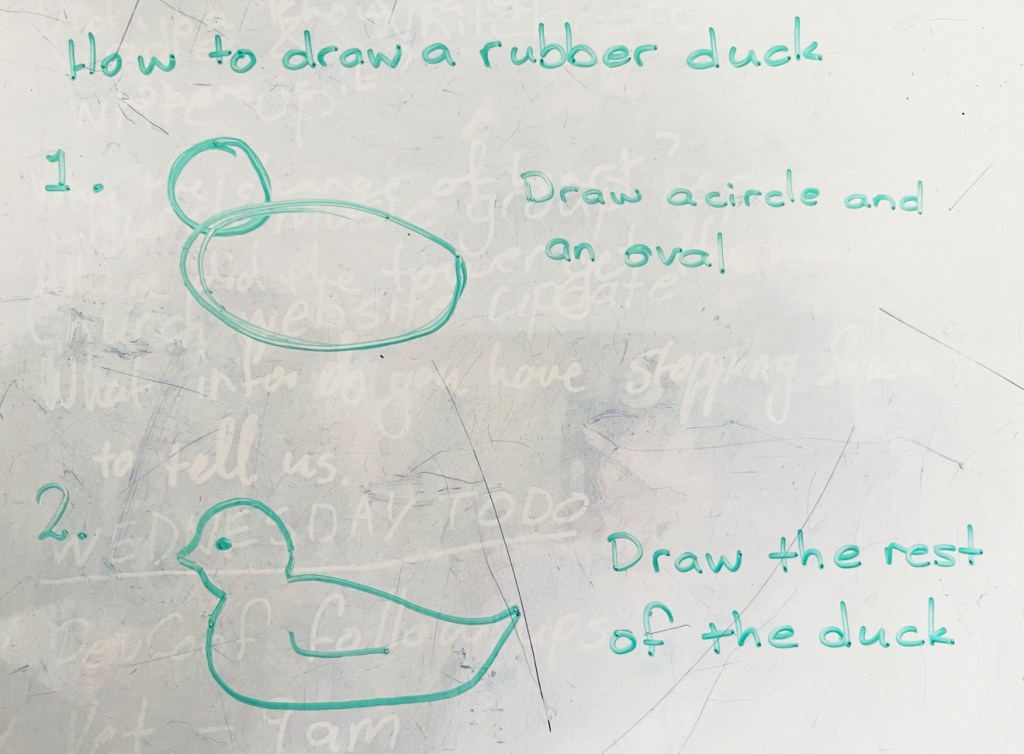
It is fascinating to me that the “big companies” have tried to get art right. Imitation, copies of other people’s work. Things which are pretty, but in the true sense of art, they are meaningless. I have been known to occasionally generate something. Take a photograph and ask a multi-modal AI to make it look like something else. It is fun, it is silly, and it is slightly neater than my “quick draw that and photograph it” which I may have done before. It is the same as doing this to a friend (who was complaining about drawing a duck):
There is something incredibly futuristic about having the ability to say to a model “draw a picture of a pelican riding a bicycle” and having it output a result. It blurs the lines of human-computer interaction. It opens up new ways of expressing oneself. If you ignore all the (very valid, we’ll get there) ethical and environmental issues around this bubble it is straight up science fiction. Like electric vehicles and vaccinations, this is something once only a dream, but now at the finger tips of almost any user. I understand perfectly why you would try.
Michael Crighton got it right.
They were so focused on whether they could, they forgot to think about whether they should.
The valid issues
Let me not repeat half-baked statistics, or painfully misunderstood metrics. Rather I will say this. Yes, data centres are a growing problem. If you don’t want them to continue to be such, you need to make bigger changes than just railing against AI. Why? They were spreading too fast before the breakthroughs. They are not a new problem, AI simply lit them up because people realised how much money was being burned. How much of the world was being burned. How much clean water is being wasted. These are not new issues. So, you want people to stop building data centres? Stop putting data in them. Rail against the machine in a manner reminiscent of the Luddites of old. Throw your cell-phone in the sea and live in a cabin with your goats.
On an ethical level, I find it far more interesting. I have written about this before. Stealing the work people poured days, months, and lives into is not okay. I don’t mean the ingestion of every public github repository. I mean the ingestion of artworks not licensed for reproduction or remixing. I mean the ingestion of Authors’ entire libraries of work. This theft, for that is what it is, has not been halted. Yet again I say, rage against the corporate machine. Throw your digital media in the pit of doom. Purchase paper books, hand painted artworks, and custom furniture. Do not be fooled into thinking that digital media lasts, or that you have any ownership of the books in your kindle. Burn DVDs of all your favourite movies, purchase the CDs of your favourite music (or the vinyl, you hipster you).
Once again. AI isn’t the cause of any of these issues. What it has done is bring them to the surface. It has made it clear to all the world that this is what happens when corporations get hold of the open-web. We see the degradation of a thing we love, and we bemoan it, but we do not fix it. “What action can I take?” I hear you ask. I don’t know. Apparently geo-politics have come into the situation. Maybe you could try voting in a local election. Apparently you are still on social media. Maybe you could try not sharing that meme, that video, that piece of digital media.
None of us wants to though.
The end I see
That desire to have nice things, that’s going to win in the end. Either because the money-grubbers run their economies into the ground (certain African nations learned that one the hard way), or because the people rise up in revolution (once, the landed gentry ruled, the French Revolution was bloody but effective). So, people will get so fed up with this thing where “a few people have everything” and will take matters into their own hands. Go read some of Cory Doctorow’s works, or any science fiction author. You will find that even in the grittiest there is a glimmer of hope in the proletariat. From Orwell’s 1984, to the newer writing. These authors know something is coming. It is on us to make it happen in our own lifetimes.
On a less revolutionary note. The one thing AI can never take from us is the joy of creation. The act of making something is still your own. To write something – no matter how small. The skill of conveying a tune with your voice or through an instrument cannot be automated. It can perhaps be imitated, but orchestras are not going away. Nor are theatres. If video couldn’t actually end the role of the radio star, how much less can AI remove the appreciation of true human skill from our psyches? You would think that streaming platforms would obviate the need for movie theatres, movie theatres for opera houses, and opera houses for small stage venues. Yet still those all continue.
So, to echo Dale Nunns. Go learn something. Go make something. Enjoy the act of socialising. Play a game, read a book. Support artists. They will always be there to speak truth to power. Give them your truth, let them tell your story. Or better yet, tell it yourself.
Go support that indy musician you love. Watch those niche films. Take that weird class. Eat home made pizza.
AI can’t even do the dishes or dust my bookshelves. It might change the shape of my job, but it is never going to take the soul out of creativity. That is an inherently human thing. It cannot be replicated, only imitated. And no mirror holds up forever.
 Pippa Hillebrand